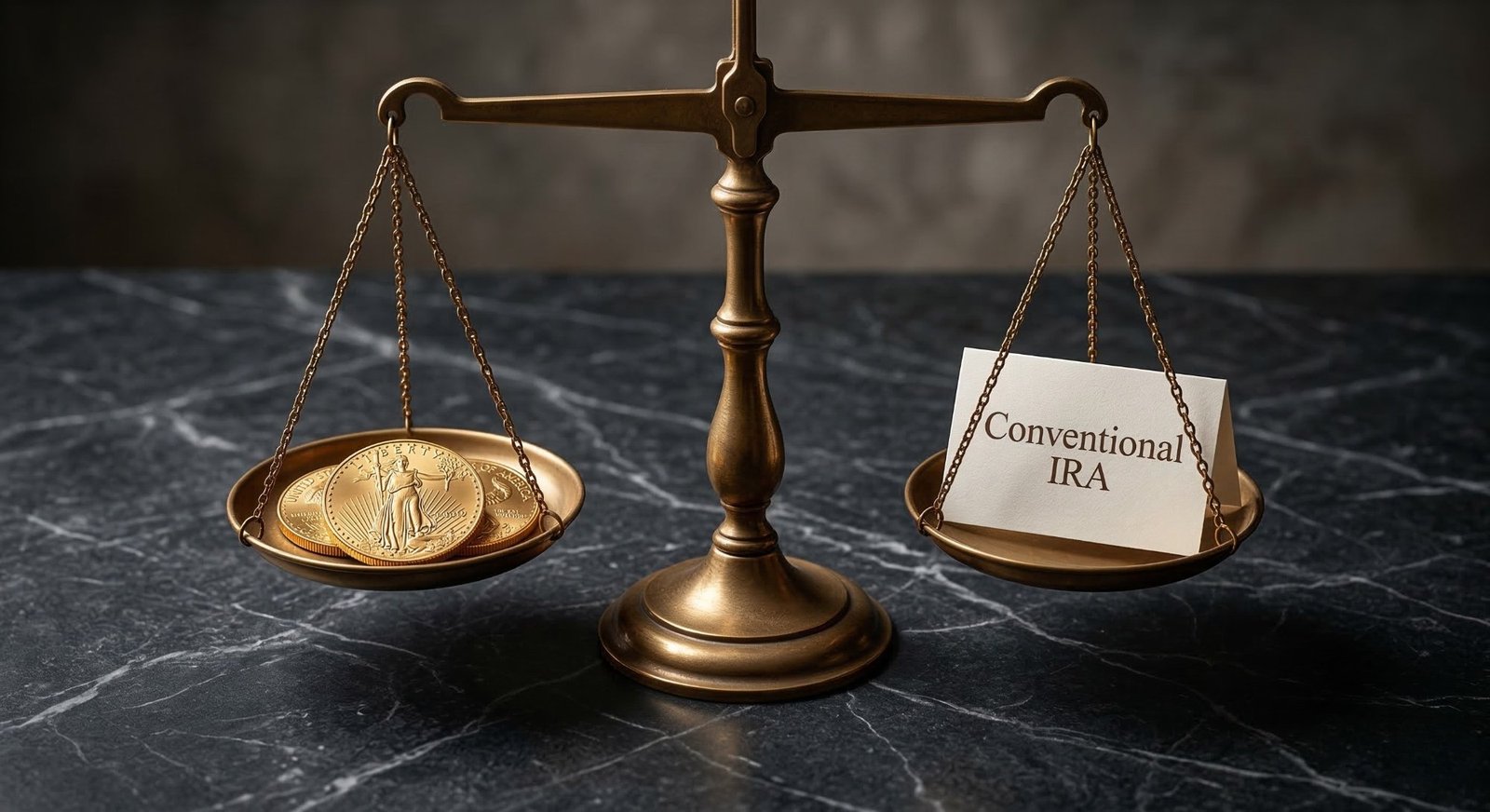

Whether a Gold IRA is a good idea depends on your specific circumstances — your account balance, retirement timeline, goals, and what you already hold. Many people wonder, is a gold ira a good idea?
This article gives you a clear, direct assessment of what a Gold IRA actually offers, what it costs, who it tends to suit, and the honest limitations that not every Gold IRA company will emphasise. If you want a full technical explanation of how Gold IRAs work first, see our Gold IRAs Explained guide.
This article addresses why some investors are concerned about whether a Gold IRA is a good idea.
In this discussion, we will explore why the question of is a gold ira a good idea continues to be relevant for many investors.
What a Gold IRA Actually Is
A Gold IRA is a self-directed individual retirement account that holds physical precious metals — gold, silver, platinum, and palladium — instead of the stocks, bonds, and mutual funds in a conventional IRA.
The account follows the same tax framework as a traditional IRA: contributions may be tax-deductible, the account grows tax-deferred, and distributions are taxed as ordinary income. A Roth Gold IRA follows Roth rules: after-tax contributions, tax-free qualified withdrawals.
Ultimately, the question of whether a Gold IRA is a good idea depends on your investment strategy and risk tolerance.
The key structural difference from a standard IRA is the asset. Rather than buying fund shares, you own physical metal that is held in your name at an IRS-approved depository. You cannot take possession of the metal while it remains inside the IRA — IRS Publication 590-A is explicit that home storage of IRA metals is not permitted.
For a deeper look at the legal structure and how it compares to a conventional IRA, see Gold IRA vs Traditional IRA.
What a Gold IRA Offers
A Physical Asset in a Tax-Advantaged Structure
Gold IRAs allow you to hold physical precious metals within the same tax-deferred structure as a standard IRA. You get the tax treatment of a retirement account applied to a physical asset — without needing to hold metals outside a retirement structure.
No Counterparty Risk on the Metal Itself
Physical gold is not a claim on another institution. Unlike a stock, bond, or ETF, the metal you own in a Gold IRA exists independently of the financial system that holds it in custody. For investors who want a portion of their retirement savings to exist outside conventional financial instruments, a Gold IRA provides that within a tax-advantaged framework.
Established Legal Framework
Self-directed IRAs holding precious metals operate under an established IRS framework — IRC Section 408(m) — in place since 1997. This is not a new or experimental structure. FINRA has published investor guidance on self-directed IRAs recognising them as a legitimate but higher-complexity account type.
Accessible via Rollover
Most Gold IRA investors fund their account by rolling over an existing 401(k) or traditional IRA — a tax-free transfer that doesn’t require new cash contributions. For investors with substantial existing retirement savings, the rollover mechanism makes reallocation possible without a tax event. Full process: How to Roll Over a 401(k) to a Gold IRA.
Important Considerations
Fees Are Higher Than a Standard IRA
Annual ongoing costs — custodian fees plus storage fees — typically range from $175 to $400 per year. Add transaction costs (metal markups at purchase) and the total annual burden is real. At a $50,000 account balance, a $250 annual fee represents 0.5% of account value annually before any metal price movement.
Full breakdown: Gold IRA Fees: What You’ll Pay
Physical Gold Pays No Income
Physical gold generates no dividends, interest, or distributions. Any return comes entirely from changes in the metal’s price. If your retirement plan requires your portfolio to generate income, physical gold holdings in a Gold IRA need to be considered alongside income-producing assets in other accounts.
Required Minimum Distributions Create Logistics
Traditional Gold IRAs are subject to RMDs beginning at age 73 — the same as a conventional IRA. When you must take a distribution, you can either sell a portion of your metals for cash, or take an in-kind distribution of physical metal (which requires the depository to ship metals to you, constituting a taxable event). The IRS RMD FAQ provides the full rules.
Lower Liquidity Than a Brokerage Account
Selling metals in a Gold IRA is not instantaneous. You contact your Gold IRA company, execute the sell transaction, and wait for settlement. This is manageable but meaningfully different from selling an ETF in a brokerage account mid-day.
You Will Not See or Touch the Metal
Your metals are held at a depository in another state. You own them legally, but you cannot access them the way you might with bullion held personally. For investors who value direct physical access, a Gold IRA is structurally different from owning unencumbered physical metal.
Who a Gold IRA Tends to Suit
Investors with larger retirement balances. The minimum investment at most reputable providers is $10,000–$50,000. Annual fees represent a smaller percentage of larger accounts, making the cost structure more reasonable. See Gold IRA Minimum Investment for a breakdown by provider.
Investors approaching or in retirement. People in their 50s and 60s with substantial 401(k) or IRA balances they’re considering reallocating are the typical Gold IRA customer — not younger investors decades from retirement.
Investors with substantial existing exposure to conventional assets. A Gold IRA is most commonly considered by people who already hold significant retirement savings in stocks, bonds, and mutual funds, and who want a portion held differently.
Investors comfortable with longer-term holding. The fee structure and lower liquidity make a Gold IRA most efficient as a multi-year to decade-plus holding rather than a short-term position.
Questions to Ask Yourself
- Do I meet the typical minimum threshold ($10,000–$50,000)?
- Am I comfortable with annual fees of $175–$400 or more?
- Does my overall retirement income strategy account for gold paying no yield?
- Have I verified the company’s BBB rating and complaint history? (Check at bbb.org)
- Am I using a direct rollover to avoid the 20% withholding on employer plans?
- Do I understand IRS storage rules and eligible metal requirements?
To protect yourself from bad actors, read our Gold IRA scams guide before making any decisions.
The Bottom Line
A Gold IRA is a legitimate, IRS-recognised retirement account structure with a documented track record since 1997. It is not right for every investor, and it should not be anyone’s only retirement account. For investors who understand the structure, meet typical minimums, and want a portion of their retirement savings held in physical metal within a tax-advantaged framework, it can be a well-considered allocation decision.
The most important variable after understanding the basics is choosing the right company. Fee structures, custodian quality, storage options, and service level vary significantly across providers.
Compare the Best Gold IRA Companies for 2026 →
Frequently Asked Questions
Yes. Physical gold prices fluctuate. The value of your Gold IRA moves with the market price of the metals held. As with any investment, principal is at risk.
No. A Gold IRA holds physical metal at an approved depository. Gold ETFs are paper securities that track gold prices — you do not own physical metal. Our gold vs ETFs comparison covers the structural differences in depth.
Check their BBB rating at bbb.org, look at the Business Consumer Alliance rating, and verify complaint history. Also confirm they use a recognised IRS-approved custodian and depository.
Yes. A “Gold IRA” can hold any IRS-approved precious metal — gold, silver, platinum, and palladium — provided each meets the relevant IRS purity standard.
Informational purposes only. Not financial, investment, or tax advice. Investing in precious metals involves risk including possible loss of principal. Consult a qualified financial advisor before making retirement investment decisions.